-
Name
-
Nausori Sugar Plantation
-
Type of carceral site
-
Plantation
-
Dates of use
-
1882 – 1959
-
Quote
-
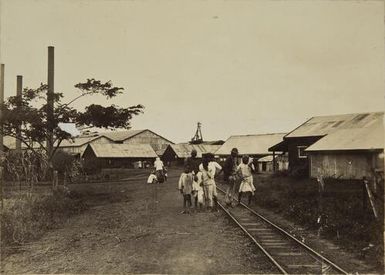
There are twenty-two long, lumber, windowless houses, with iron roofs, divided into apartments of 10x12 feet. One of these rooms is assigned to a family, or in case of single men, three of these to a room.
Labour History.
The Fijian Islands: A Description of the History, Inhabitants, Productions, and Present Condition of Fiji. London: Religious Tract Society, 1894, p. 101.
-
We are known in different parts of the South Pacific Ocean, for being inflicted with the disease of song. Even the moon drops down low to experience the music from our tongues and throats.
Narrative Poetry.
Anjali, Manisha. Naag Mountain. Giramondo Publishing, 2024, p. 95.
-
On May 28, 1893, I became an indentured labourer of the Colonial Sugar Refining Company of Fiji and arrived in the Nausori sector of the Rewa district. There were 140 others with me. On the order of the Sector Manager, a European overseer came and began allocating everyone quarters in the coolie lines. All my companions were given accommodation except me. The overseer told me that as there was no room left in the lines, I would be placed in the haunted line. [...] The haunted line was situated six chains apart from the other 26 lines. It had once been used to house the Company's Fijian workers. When eight of its Fijian residents died because of some illness, the remaining workers abandoned the line and fled. Hence its name. No one would agree to live there and no one walked past it at night. New arrivals joined the others and at the once collected seven days' rations consisting of flour (3 seer), dhal (1 seer), ghee (1,4 seer), salt (1fa seer), etc. As I began to walk towards the lines, the manager said: 'This ration is to last for seven days. Don't sell, barter or share it. Anyone disobeying this order can face 1-3 weeks imprisonment. If you finish your ration early, then you will have to starve. This office will not give out rations in the middle of the week.' After listening to the order, I left for my line thinking to myself: 'What a country this is where sharing food is an offence punishable by imprisonment. Oh Lord! Who knows what else is to come.'
Autofiction.
Totaram Sanadhya. "The Story of the Haunted Line." Translated by Brij Lal and Barry Shineberg. The Journal of Pacific History, vol. 26, no. 1 (1991): 107.
-
The harsh treatment of indentured labourers in a whole host of ways led them to describe life on plantations as narak – hell.
Labour History.
Moynagh, Michael. Brown or White? A History of the Fiji Sugar Industry, 1873–1973. Australian National University Press, 1981, p. 48.
-
Many such girmityas died alone: uncared for, unmourned, unremembered, thousands of miles from where they were born.
Novel/Autobiography.
Nandan, Satendra. Nadi: Memories of a River: Faces in a Village. Landmark Publications, 2014, p. 48.
-
In 1905 CSR's Labasa manager had hoped to settle Indians on condition that they work as required for 1s 3d a day but the free market wage of time-expired labourers was often nearer to 1s 6d, though it did vary.
Labour History.
Moynagh, Michael. Brown or White? A History of the Fiji Sugar Industry, 1873–1974. Australian National University Press, 1981, p. 107.
-
Authority
-
Native Land Ordinances (1875, 1880, 1905); Indian Immigration Ordinance 1879; Master and Servants Ordinances (Fiji)
-
Archives and sources
-
ANU/Pacific Manuscripts Bureau, Canberra.
Fiji Museum (Suva).
Global Girmit Museum, Lautoka (Fiji).
Gillion, K.L. Fiji's Indian Migrants: A History to the End of Indenture in 1920. O.U.P., 1962.
Graves, Adrian. Cane and Labour: The Political Economy of the Fiji Sugar Industry, 1862–1906. Edinburgh University Press, 1993.
Lal, Brij V. Girmitiyas: The Origins of the Fiji Indians. Journal of Pacific History, c1983.
Moynagh, Michael. Brown or White? A History of the Fiji Sugar Industry, 1873–1974. Australian National University Press, 1981.
National Archives of Fiji (Suva).
-
Contact
-
Kieren
-
identifier
-
SITE-NSP