-
Name
-
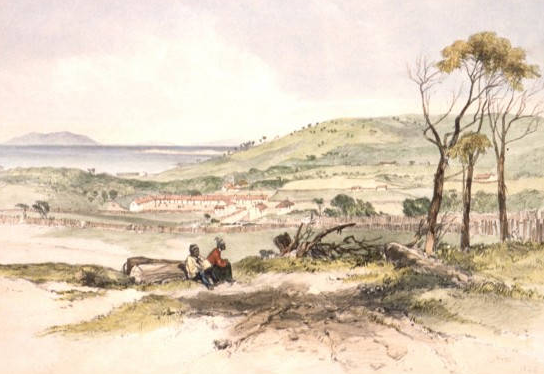
Wybalenna Aboriginal Establishment
-
Type of carceral site
-
Reserve, Station, or Mission
-
Dates of use
-
1834 – 1847
-
Quote
-
The village was named "Wybalenna,'' signifying, in. the language of the Ben Lomond tribe, 'Blackman's Houses.' There were at this time 111 aborigines on the island-55 males and 56 females. Of the whole number only 16 were children. Wybalenna was a much better location than The Lagoons. There was sufficient water, good pasturage, and land fit for cultivation as gardens. The officers of the establishment had weatherboard houses, and about twenty thatched wattle and plaster hi1ts had been built for the blacks.
Report, Aboriginal History.
Walker, George Washington. Notes on the Aborigines of Tasmania: Extracted from the Manuscript Journals of George Washington Walker; with an Introduction and "Some Notes on the Tribal Divisions of the Aborigines of Tasmania," by James B. Walker, F.R.G.S. William Grahame, Jun., Government Printer, 1898, p. 6.
-
At the heart of the settlement is the Native's Square, defined by the L shaped terrace of cottages and the chapel. Ranged around the centre is accommodation for the settlement staff including the commandant, store keeper, convict prisoners, chaplain, soldiers and the medical officer. An enclosed garden is provided for each of these and there are stockyards and a large paddock. A network of roads and tracks links the parts of the settlement and provides access through the surrounding scrub and trees. Within the bush to the south of the settlement Robinson identified two clearings; one used for "Native Weddings" according to the rites of the Scotts Church and the "Native Strawberry Garden" which he says was cleared, fenced.
Aboriginal History.
Birmingham, Judy, and Andrew Wilson. "Archaeologies of Cultural Interaction: Wybalenna Settlement and Killalpaninna Mission." International Journal of Historical Archaeology, vol. 14, no. 1, 2010, pp. 15-38: p. 19.
-
In the main, however, they simply died—of accidie, deracination and new diseases. In 1835, only 150 Aborigines were left. Little by little, they wasted away and their ghosts drifted out over the water.
Aboriginal History.
Hughes, Robert. The Fatal Shore: A History of the Transportation of Convicts to Australia. Vintage, 1987, p. 438.
-
"Once again he was fated to be uninhabited for some thousands of season. When was the last time a sizeable population had wandered over his skin? Ten or twenty thousand years ago. He couldn't be more exact, for what was exactitude to an immortal? The seasons succeeded heach other in a slow rolling which contrasted with the quick dash of the sun.
Novella.
Johnston, Colin. Master of the Ghost Dreaming. Angus and Robertson, 1991, p. 99.
-
They live in an artificial society where most of their traditional food resources have been hunted out, and living in damp poorly ventilated huts with impure water and inadequate provisions.
Aboriginal History.
Lyndall, Ryan. The Aboriginal Tasmanians. University of Queensland Press, 1981, p. 203.
-
I want now to tell the Govr that Dr. Jeanneret wants to make out my husband & myself very bad wicked people & talks plenty about putting us into jail & that he will hang us for helping to write the petition to the Queen from our country people. I send the Gov. two papers one from Dr. Milligan & one from Mr. Robinson of Port Philip to tell the Govr that they know us a long time & had nothing to say bad of us but Dr. Jeanneret does not like us for we do not like to be his slaves nor wish our poor Country to be treated badly or made slaves of. I hope the Govr will not let Dr. Jeanneret put us into Jail as he likes for nothing at all as he used he says he will do it & frightens us much with his big talk about our writing to the Queen he calls us all liars but we told him & the Coxswain who Dr. Jeanneret made ask us that it was all true what we write about him.
Letter.
Mary Ann Arthur. "Letter to Colonial Secretary, Van Diemen's Land." Macquarie PEN Anthology of Aboriginal Literature, edited by Anita Heiss and Peter Minter, Allen & Unwin, 2008, pp. 11–12.
-
Authority
-
Black Line (1830); Aborigines Protection Act (1838); Establishment of Wybalenna (1834)
-
Archives and sources
-
Australian Institute of Aboriginal and Torres Strait Islander Studies, Canberra.
Birmingham, Judy, and Andrew Wilson. "Archaeologies of Cultural Interaction: Wybalenna Settlement and Killalpaninna Mission." International Journal of Historical Archaeology, vol. 14, no. 1, 2010, pp. 15-38.
Cameron, Patsy. Grease and Ochre: The Blending of Two Cultures at the Colonial Sea Frontier. Fullers Bookshop, 2011.
Queen Victoria Museum and Art Gallery, Launceston.
State Library of Tasmania.
Tasmanian Archives and Heritage Office.
-
Contact
-
Kieren
-
identifier
-
SITE-WYB