-
Name
-
Darlington Penal Settement
-
Type of carceral site
-
Penal Settlement
-
Dates of use
-
1825 – 1832
-
1842 – 1850
-
Quote
-
The Commandant resided on the hillslope to the south, overlooking the settlement [...] allowing surveillance over the prisoners by those in charge.
Autobiography/Memoir.
Mundy, Godfrey Charles. Our Antipodes: Or, Residence and Rambles in the Australian Colonies, Vol. II. Richard Bentley, 1852, p. 295.
-
Among the people exiled to the isle were several of the Māori chiefs who had been concerned in the New Zealand rebellion [...] Hohepa Te Umuroa [...] died July 9th, 1847.
History.
Lord, Clive. "The Early History of Maria Island." Papers and Proceedings of the Royal Society of Tasmania, 1919, issued 16 March 1920, pp. 39-54: p.48.
-
The Government considered that the island would make an excellent convict station, as not only was it a natural penitentiary but appeared to be a suitable locality in which to grow flax.
Report.
Lord, Clive. "The Early History of Maria Island." Papers and Proceedings of the Royal Society of Tasmania, 1919, issued 16 March 1920, pp. 39-54: p. 47.
-
Authority
-
Lord Bathurst's Directive (1819); Governor Arthur's Penal Expansion (1825); Lord Stanley's Probation System (1842-1853); Transportation and Probation Act (1834-1847)
-
Archives and sources
-
Lempriere, Thomas James. Diary, Port Arthur, 1 January 1837–12 September 1838. Manuscript diary, 112 leaves. State Library of New South Wales. https://collection.sl.nsw.gov.au/record/npAdZV51.
Lord, Clive. "The Early History of Maria Island." Papers and Proceedings of the Royal Society of Tasmania, 1919, issued 16 March 1920, pp. 39-54.
Morris, J. R. "Early Convict History of Maria Island." Papers and Proceedings: Tasmanian Historical Research Association, vol. 11, no. 4, July 1964, pp. 157-177.
Tasmanian Archives and Heritage Office (TAHO).
-
Contact
-
Kieren
-
identifier
-
SITE-MR
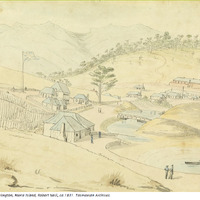 Maria Island, Wukaluwikiwayna